An Ode to the Chand-Gari: Bahawalpur's Unregulated Public Transport
For most of us, commute means a ride in a public transport vehicle or on a train. Your journey is usually accompanied with conversations with random strangers, a carefree look through the glass panes of a side-window, and plenitude of time to contemplate on life.
As human population continues to increase swiftly and our cities keep on expanding, public transport is becoming a global ubiquitous necessity. Millions of people who do not own personal vehicles depend upon these intricate networks to reach their homes, workplaces, family and friends, hospitals, community resources and recreational activities.
In this context, is public transport a boon exclusively provided and regulated by the government or is it a natural consequence of human needs and interactions? This article argues that it is the latter. Public transport stems from the natural need for human civilization and cities give birth to these vessels that transport their dwellers across their concrete interiors.
A Brief History of Getting Around
For a long time, geographical mobility was a privilege reserved exclusively for the elite. Nobles and Kings would own horses, camels and mules to commute from one location to another with relative ease. Peasants who did not own any riding animals could only walk to their destinations.
Somewhere along this road, entrepreneurs seeking a fortune must have realized the business potential of helping people commute between places, bringing out animal-drawn carts that anyone could hop on for a nominal fee. Over time, the old world embraced public transport in a multitude of ways, ultimately paving the way to our train and bus transit networks.
Today, due to the sheer and ever-expanding size of human cities and the massive distances between settlements, it has become impossible to walk long distances. As a result, public transport is made largely accessible in nearly every human settlement in the world. Interestingly, everywhere in the world, public transport has evolved with the community that hosts it, creating a wonderful diversity in the kinds of vehicles we can see on the streets.
Bahawalpur and Its Public Transport
Bahawalpur is a major city in the province of Punjab in Pakistan, renowned for its oft-photographed palaces, vibrant desert culture, and massive military forts dotting its area. Earlier to its accession into the State of Pakistan, Bahawalpur was one of the 562 princely states present in the subcontinent prior to its partition into India and Pakistan.
The first recorded development of public transport in the city can be traced to horse-drawn carts that would take people around the city as well as nearby settlements. In the later years, a fleet of bicycle-drawn rickshaws proliferated on the roads, remaining relevant until the early 1990s. In recent years, citing traffic concerns, the government encouraged people to adopt motorized vehicles to prevent traffic congestion.
With the arrival of motorized vehicles came a steady deployment of specialized auto-rickshaws (tuk-tuks) and yellow taxis that started providing their services to the people, mostly travellers arriving in the city. As the city continued to expand, it became clear that not everyone could afford the individual charges of these taxis and auto-rickshaws. People needed something far more efficient and affordable — thus the Chand-gari was born.
What Is the Chand-Gari?
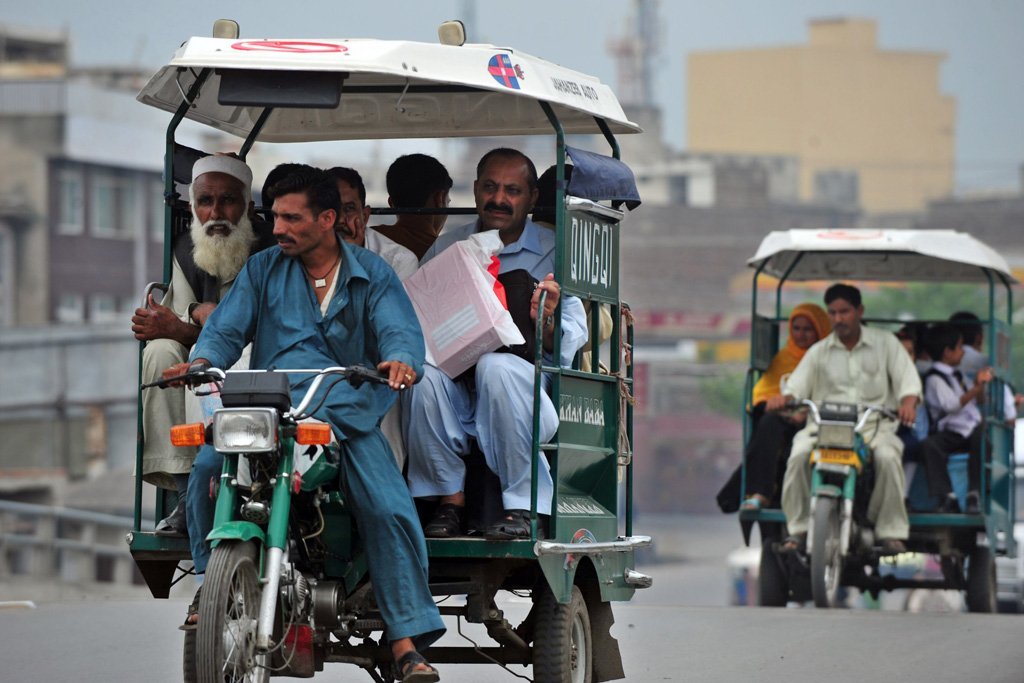
Literally meaning “the vehicles from the moon,” the Chand-gari is, in mechanical terms, a Frankenstein monster — a contraption created by welding different parts of machines together to create something entirely new. While little is known about why they were named as such, these vehicles dot the entire city of Bahawalpur, travelling around in designated routes to transport people.
The average Chand-gari is little more than extra seats attached to a motorcycle.
They Transport Thousands of People a Day
According to rough estimates, there are over 500 Chand-garis operating in Bahawalpur. In an “ideal” situation — where ideal is from the eyes of the driver — a Chand-gari can carry six people at a time, most of which are travelling short distances to landmark points all around the city.
Many Chand-garis also operate on longer routes, taking people to and fro from the city to nearby settlements located several kilometres away. These routes are highly economical for thousands of workers who use these vehicles for commuting from their villages to their workplaces.
A Unique Organizational Culture
Despite being unregulated, the Chand-gari drivers have a rigid organizational structure where there is democratic selection of the city head — the formal President of the organization. He is responsible for carrying out all the decisions in the interest of the vehicle drivers and for handling any issues that might arise in their distinct community.
“The President has our back if we get into trouble with the traffic police officers; that is why we elect him!”
Infamous for their reckless driving and a unilateral purpose to pick up as many people as they can in the shortest amount of time, Chand-gari drivers have frequent brush-ins with traffic police officers. However, these encounters come with an unconventional complication: the Chand-gari does not fall under any regulations.
Technically, the Chand-Gari Is Illegal
Owing to its rag-tag contraption and usage, the Chand-gari does not fall under any of the vehicles recognized in the relevant laws of Pakistan that outline strict guidelines for the fitness and construction of vehicles. As a result, the Chand-gari cannot be regulated by the traffic administration of Bahawalpur, creating a legal vacuum.
“We can’t regulate these vehicles as they are not commercial vehicles recognized under law. It’s also impossible to stop them as they generate a large amount of economic activity while transporting thousands of people.” — A traffic police officer
While many might argue that the drivers of these vehicles enjoy and even exploit the legal freedom they get, there is actually a fair amount of discipline in their ranks. Over time, their discipline has managed to evolve a culture that sustains their presence and their services, helping them carve a significant place in the hearts of the citizens of Bahawalpur.
Out of Many, One
The drivers maintain a unique social culture that they strongly adhere to, allowing them to systematically continue their operations with little hindrance. To the outsiders, they are only competitors on the hunt for the next customer, but on the inside, they are a tightly-knit community that looks out for each other.
“I will not go to a place where my fellow drivers don’t normally go, I need my fellows to be around me just in case there is any trouble.”
Drivers of Chand-garis maintain strong rules regarding the routes they take. If someone breaks away, he might get caught in trouble alone. Within a legal vacuum, just as there exists a sense of freedom, there is also a significant lack of protection. Chand-gari drivers, despite their contribution to the city’s public transport network, do not enjoy any legal protection and are, nearly at all times, under the keen observation of the city administration that wishes to shut them down.
However, due to their continued economic contribution and the deep entrenchment of their services in the fabric of the city, the Chand-gari continues to thrive — a testament to how public transport is less a government service and more an organic expression of human community.
Sources & Further Reading
- Originally published on IVolunteer International — Read the original article
- Dawn News — Bahawalpur — Regional coverage of Bahawalpur’s urban affairs
- Xinhua — Pakistan Transport — Coverage of Pakistan’s transport sector
- Sustainable Development Goals — Transport — SDG 11: Sustainable Cities and Communities